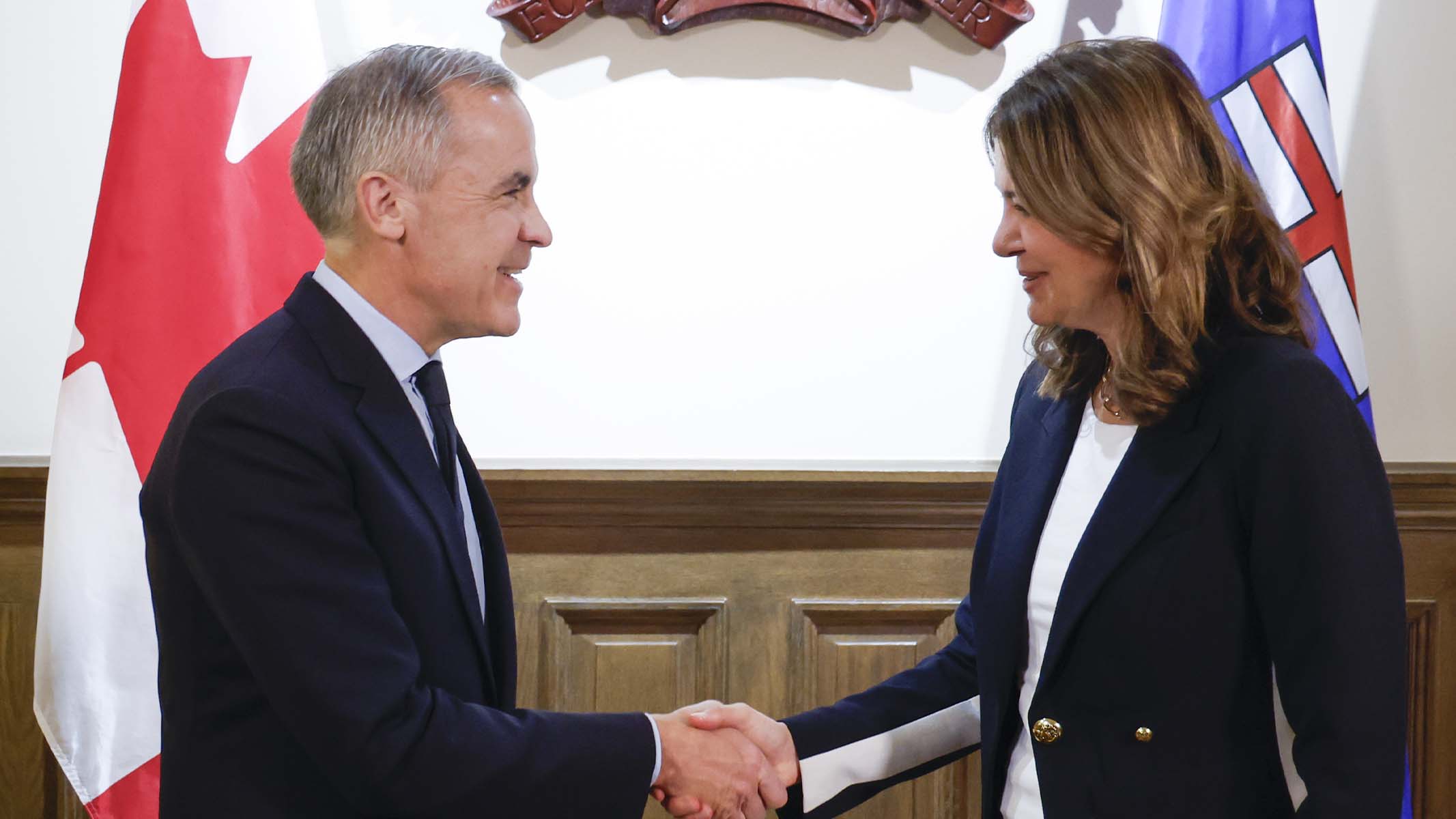
Alberta Premier Danielle Smith and Prime Minister Mark Carney both say they’re open to alternate routes for a potential pipeline to get Alberta oil to Asian markets, which does not necessarily need to end at B.C.’s northwest coast.
“Some of the alternatives are already emerging,” Smith told reporters in Ottawa on Thursday, when asked whether the northwest coast route is the only one being considered.
Prime Minister Mark Carney and Alberta Premier Danielle Smith both say they’re open to alternate routes for a potential pipeline to get Alberta oil to Asian markets, which does not necessarily need to end at B.C.’s northwest coast.
She said several options to boost oil exports are currently being considered, including an expansion of Enbridge’s main line and exploring ways to better utilize old Keystone assets, among other ideas.
“North, south, east, west, we’re willing to go in every direction,” Smith said.
Smith has been at odds with B.C. Premier David Eby over the issue for months. In June, Eby said he wouldn’t support a new pipeline — arguing the Trans Mountain Expansion Project is already in place — to which Smith responded that she would “convince” him.
Then, in November, Carney and Smith signed a historic memorandum of understanding (MOU) outlining the conditions that need to be met for a new oil pipeline to the Pacific to proceed.
In the MOU, Alberta agreed to negotiate an industrial carbon pricing agreement by April 2026, which would implement an industrial carbon price with a floor of $130 per tonne.
In return, the federal government has agreed not to implement the oil and gas emissions cap, to suspend the clean electricity regulations in the province, and if required, make an exemption to the federal tanker ban.
But Eby has been staunchly opposed to lifting the tanker ban, which was enacted in 2019 and prohibits oil tankers carrying more than 12,500 metric tons of crude or persistent oil from docking, loading or unloading at ports on the B.C. north coast.
“We are doing our work to put the project together by June, and we are hoping that the federal government can move swiftly on making a decision so we can get down to technical details on that,” Smith said on Thursday.
“I’m very confident that once approved, we will have one or more strong proponents in the private sector willing to work with us to build it.”
Asked to respond, Eby said Smith is “committed to keeping (B.C.) updated on her progress,” and that he looks forward to that.
Canada’s premiers are in Ottawa this week for a meeting of the Council of the Federation. On Thursday, they also collectively sat down with Carney, largely to discuss trade amid the ongoing trade war with the United States.
While they’re in town, a few also met with Carney separately, including Smith and Eby, who said pipelines were a topic of conversation.
The B.C. premier described the sit-down as “very civil,” and “borderline friendly.”
Speaking to reporters on Thursday, Carney said he wanted to “re-emphasize” that the MOU includes many other provisions, including cooperation on data centres, nuclear power, and inner ties.
“With respect to a route, and under the MOU, ‘a bitumen pipeline to Asian markets,’ is the way it’s described, and therefore the specific routes are not outlined,” Carney said.
“Of course, work is being done to explore the feasibility of various routes, and there are many factors that affect the feasibility, starting with Indigenous support, as well as technical and economic considerations,” he also said.
Alberta is currently acting as a proponent to fund the initial planning stages of a proposed bitumen pipeline to B.C. northwest coast, and Smith re-asserted her desire on Thursday to present a proposal to the Major Projects Office by June.
“We are hoping that the federal government can move swiftly on making a decision so we can get down to technical details on that,” Smith said. “I’m very confident that once approved, we will have one or more strong proponents in the private sector willing to work with us.”
A private proponent for a pipeline has yet to come forward.
With files from CTV News’ Stephanie Ha