British Columbia’s Workers’ Compensation Board is urging employers to ensure their employees’ safety when working in avalanche terrain, after four deaths in two separate slides over the weekend.
WorkSafeBC has issued an information bulletin reminding employers that they’re required to make sure employees are not exposed to avalanche hazards as part of the board’s Occupational Health and Safety Regulation.
It says the board accepted 23 injury claims between 2014 and 2024, including one case involving a fatality and 11 serious injuries.
The notice comes after a deadly Sunday in B.C., where three heli-skiers were killed on Mount Knauss north of Terrace and another skier died in the remote northwest region of the province 500 kilometres from Atlin.
The skier killed near Atlin was reportedly in a group of five people on a ski tour, when they set off the slide during a descent from a slope.
The victim was fully buried under 1.5 metres of snow.
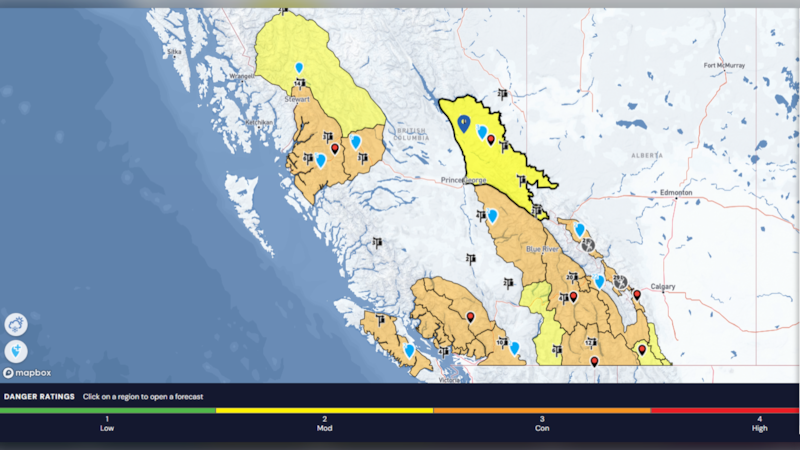
Avalanche Canada had warned of high to extreme slide risks last week into the weekend, as an atmospheric river event brought heavy precipitation and warm temperatures as well as winds that forecasters said could destabilize certain terrain.
Environment Canada has issued a winter storm warning for the Pine Pass area Tuesday. Those working in the area should expect 15 to 25 centimetres of snow and near zero visibility on the roads.
Avalanche Canada says there is a moderate chance of an avalanche in the Pine Pass area. Wind chill values could also reach -25°C to -30°C.
“When workers are required to enter or work near avalanche terrain — whether for guiding, resource work, maintenance or other purposes — employers have a responsibility to assess those risks and take all necessary steps to protect workers,” the WorkSafeBC bulletin says.
“This includes ensuring a qualified person conducts an avalanche risk assessment, and that an avalanche safety plan is developed and implemented where required,” the bulletin adds. “Employers must also ensure conditions are continuously monitored, workers are properly trained, supervised, and informed, and that work is postponed or stopped when conditions are unsafe.”
With files from The Canadian Press.