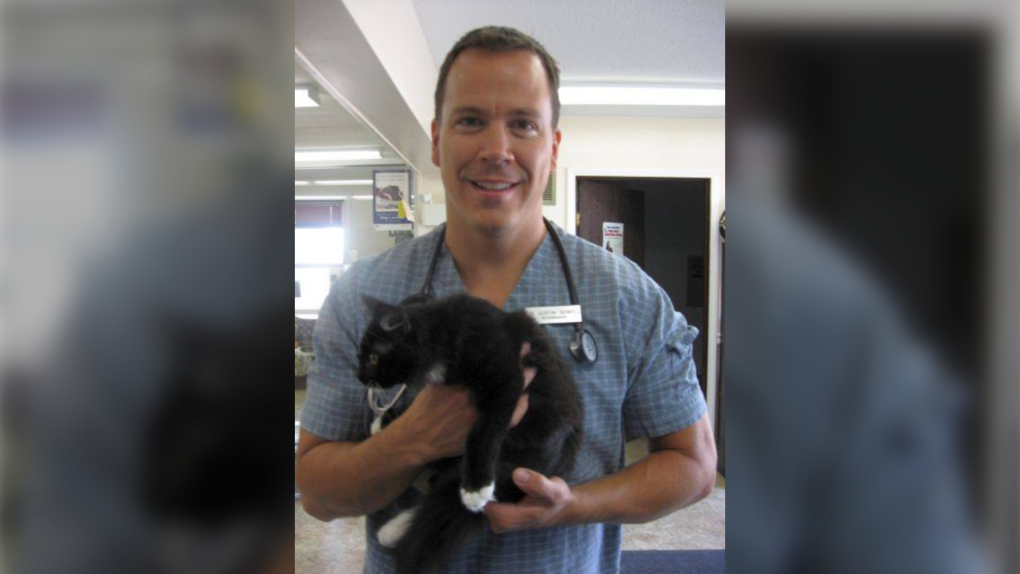
A Fort St. John man who drugged, sexually assaulted and took illicit photos of his sister-in-law, must stay in prison while his appeal his being heard.
Justin Sewell is asking the Supreme Court of Canada for permission to appeal his sentence. Back in October, BC’s highest court ruled Sewell must do prison time, allowing his sentence to be served in the community to be overturned.
The Supreme Court of Canada is expected to give its decision on whether or not to permit Mr. Sewell to appeal, by sometime in mid 2026.
Sewell had asked to be released on bail until the court rendered its decision. That request was denied, so he will remain in custody according to the BC Prosecution Service.
Sewell, a veterinarian from Fort St. John, pleaded guilty to one count of sexual assault and two counts of voyeurism and was handed a conditional sentence earlier this year.
The crimes took place in 2007, when the victim was living with Sewell, his wife and their children, according to a B.C. Court of Appeal decision published Tuesday.
“While his wife and children were away, (Sewell) surreptitiously added ketamine or Valium to (the victim’s) drink, rendering her incapacitated. The respondent then sexually assaulted (her) and took photographs of her naked body. (She) did not have a clear memory of the sexual assault, but she did remember waking up to the respondent removing her shorts and underwear,” the decision said, summarizing the offences.
“On other occasions, the respondent took photographs of (the victim) through her bedroom window.”
A provincial court judge sentenced Sewell to two years less a day on the sexual assault charge, six months on the first voyeurism count and three months on the second. The sentences were to be served concurrently, which meant Sewell was eligible to avoid time behind bars because the total sentence was below the two-year threshold.
However, the appeal court found it was an error to allow the sentences to be served concurrently.
“The judge failed to consider the invasions of (the woman’s) privacy interests caused by the voyeurism offences, as distinct from the invasion of her bodily integrity caused by the sexual assault. He also failed to consider the fact that the (first) voyeurism offence arose from an entirely different incident from (the second),” the Appeal Court found.
The conditional sentence order was set aside, and a prison term was imposed.
The confession
One of the central mitigating factors cited in the original sentencing decision was Sewell’s confession, which came 14 years after the sexual assault and voyeurism occurred.
The appeal decision outlined the circumstances of the offences, noting that the woman had known Sewell since she was a child and “came to view him as an older brother.”
Sewell slipped drugs into the woman’s drinks when she was 20, on a night when he “offered to provide a safe environment for (her) to get drunk for the first time,” the decision said.
She did not have a clear memory of what happened but did know “something terribly wrong had occurred,” according to the appeal decision.
In 2014, the victim learned the photos existed and cut off contact with her brother-in-law.
Five years after that, a colleague of Sewell’s told the woman that Sewell had admitted to drugging, sexually assaulting and photographing her, the decision said.
The woman made a police report in 2019. Two years after that, a plan to elicit a confession was put in motion.
“The police proposed that (the woman) become a police agent to attempt to obtain a confession from the respondent,” the judgment said, adding that Sewell agreed to fly to Vancouver and meet the woman at a restaurant.
“(She) recorded the meeting.”
Sewell admitted to drugging, sexually assaulting, and photographing the woman and the appeal court decision noted that “much of the information (Sewell) provided was new to (her.)”
Charges were approved in 2022 and Sewell pleaded guilty early in the process, according to the Appeal Court.
The original sentencing decision
Crown asked the sentencing judge to impose a prison term of four and a half years, emphasizing the aggravating factors in the case.
Those included Sewell drugging the victim, abusing a position of trust, and assaulting her in a place she should have been safe.
“The sexual assault was prolonged; the sexual assault involved invasive, violative, and demeaning conduct; the respondent used (the victim) for his own sexual gratification with no apparent thought for the effect of his actions on her,” the appeal decision said, outlining additional aggravating factors.
The impact on the woman was also “devastating,” the decision said.
“There is no question that the respondent’s sexual assault of (the woman) was an extremely grave violation of her bodily autonomy, sexual integrity, and dignity that caused her profound and ongoing emotional and psychological harm,” the appeal decision said, summarizing what the woman told the court.
Sewell’s confession, his guilty plea, his expression of remorse, lack of a criminal record and low risk of re-offending were considered mitigating.
The sentencing judge opted for concurrent sentences, in part, because he found consecutive sentences would be “unduly long and harsh” in the circumstances, according to the decision.
This decision, the appeal court found, “wrongly skewed by the judge’s conclusion that a (conditional sentence order) was appropriate” and constituted an “error in principle.”
The high court ruled the sentences for the voyeurism offences should be served consecutively to the sentence for the sexual assault, for a total prison term of 33 months.
With files from Lisa Steacy CTV Vancouver