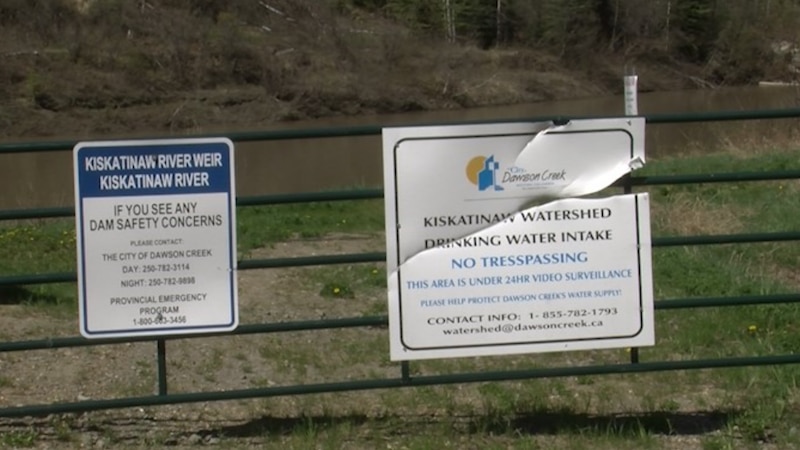
DAWSON CREEK, B.C. - Dawson Creek officials say the Kiskatinaw River remains one of four options being considered for the community’s future water supply, despite the fact that recurring drought concerns in the watershed helped prompt the City’s Water Supply System Project, in the first place.
The explanation comes after the City released the results of a major feasibility study that narrowed a long list of potential water sources to four options including the Kiskatinaw.
The study was launched to address long-term concerns about drought, climate change, population growth and the City’s dependence on a single source of water.
Four options still under consideration:
- Kiskatinaw River (baseline option)
- Peace River (Clayhurst)
- Peace River (Taylor)
- Pine River
CJDC TV News asked the city why the Kiskatinaw River was included as a future option when reliability concerns with the river helped trigger the review process.
According to the City, the Kiskatinaw River was retained as a baseline option because the alternative sources under consideration would require significant capital investment and council needs to fully understand the costs and implications of every available path forward.
Officials say keeping the Kiskatinaw in the analysis allows the City to evaluate what improvements could be made to strengthen the resilience of the existing system if a transition to a new source is ultimately deemed unaffordable or unnecessary.
The study identified several measures that could improve the reliability of the current system, including making temporary overland water transfer infrastructure permanent for emergency use, expanding water storage capacity and increasing financial reserves to help the City respond to future periods of water scarcity.
Why Murray River was dropped
The City also provided additional details about why Murray River options were not advanced beyond the first phase of the study.
According to officials, the Murray River was evaluated alongside other potential sources but was found to be less favourable than the options being carried forward.
Three primary concerns were identified during the Phase 1 assessment: climate resilience, constructability and water treatment requirements.
As a result, the Murray River and Murray River South alternatives were not recommended for further focus at this stage, leaving the Kiskatinaw River baseline option, two Peace River options and the Pine River option under active consideration.
However, City officials stress that being omitted from the current shortlist does not permanently eliminate the Murray River from future consideration.
They say the purpose of Phase 1 was to narrow the field of options based on available information and identify the alternatives that warrant more detailed investigation.
If new information emerges or circumstances change, previously rejected options could be revisited.
No preferred source selected yet
The City has repeatedly emphasized that the feasibility study was not intended to select a preferred water source. Instead, the process was designed to reduce uncertainty, answer technical questions and provide council with information needed to guide future decisions.
A future report to council is expected to outline recommendations on how the project should proceed, including whether further study of the remaining options is warranted. For now, officials say no final decision has been made on Dawson Creek’s long-term water source.
Price tag into hundreds of millions
The feasibility study also provides the first detailed comparison of planning-level costs for each option.
The current Kiskatinaw River system would require an estimated $55 million in capital investments over the next two decades, with a lifecycle cost of approximately $85 million.
Among the new source alternatives, the Pine River option carries the lowest estimated capital cost at roughly $194 million, while the Peace River Clayhurst and Taylor options are estimated at approximately $255 million and $272 million respectively.
The report notes those figures are preliminary Class D estimates and include significant contingency, engineering and inflation allowances.