
FORT ST. JOHN, B.C. - A new poll released just two days after Premier David Eby called a snap provincial election suggests the BC Conservatives have opened up an eight-point lead over the governing BC NDP, though many British Columbians remain undecided and uncertain about their vote.
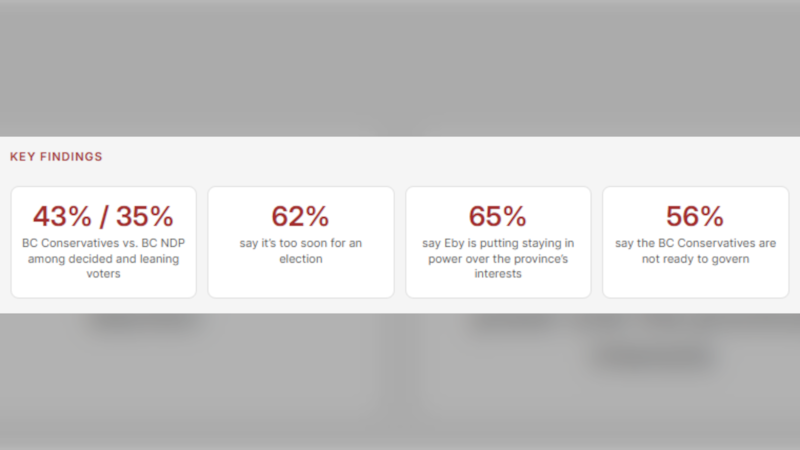
The latest survey from the Angus Reid Institute found the BC Conservatives sitting at 43 per cent support among decided and leaning voters, compared to 35 per cent for the BC NDP.
The numbers mark a significant shift from earlier polling this month, when the New Democrats held a narrow advantage.
The poll comes in the immediate aftermath of Eby’s decision to dissolve the legislature and send voters to the polls on October 24.
According to the survey, many British Columbians are questioning the timing of the election call.
Nearly two-thirds of respondents, 62 per cent, said it is “too soon” for a provincial election, while 65 per cent believe Eby is putting his own political interests ahead of the province’s by calling the vote now.
Even among BC NDP supporters, more than half said it is too soon to head back to the ballot box.

Conservatives benefit from renewed unity
The poll was conducted as the BC Conservatives completed a reunification deal with seven MLAs who had previously defected to CentreBC, helping bring the fractured right-of-centre movement back under one banner.
The party is currently led by interim leader Lorne Doerkson, who would become premier if the Conservatives form government following the election.
Despite months of leadership turmoil and caucus infighting, the Conservatives appear to have maintained much of the support they received in the 2024 election.
The Angus Reid Institute found 85 per cent of past Conservative voters are prepared to support the party again, compared to 65 per cent of previous BC NDP voters who say they will stick with the governing party.
Voters remain undecided
While the Conservatives hold an early advantage, the survey suggests the campaign is far from settled.
One in five British Columbians said they remain undecided about how they will vote, while only 35 per cent described themselves as “very certain” about their current choice.
The poll also found a sizeable portion of the electorate remains dissatisfied with the available options.
Nearly four in 10 respondents said they do not feel they have a good choice if forced to choose between the province’s two leading parties.
Cost of living tops voter concerns
When asked what issues will drive their vote, British Columbians overwhelmingly pointed to affordability concerns.
Fifty-nine per cent cited the cost of living and inflation as a top issue, followed by health care at 42 per cent.
Other concerns included the economy and jobs, housing affordability, public safety and the provincial deficit.
The poll found concerns vary significantly by party affiliation. Conservative supporters were more likely to focus on government spending, public safety and economic issues. BC NDP supporters placed greater emphasis on health care and the ongoing effects of U.S. tariffs.

Questions remain about readiness to govern
Despite the Conservatives’ lead, a majority of British Columbians are not fully convinced the party is prepared to take power.
The Angus Reid Institute found 56 per cent of respondents believe the BC Conservatives are not ready to govern the province.
Even among current Conservative supporters, about one in five expressed reservations about the party’s readiness for government.
The survey also found many voters remain unfamiliar with key opposition figures. Two in five respondents said they do not know enough about Doerkson to form a positive or negative opinion.
Early days in the campaign
With a month remaining before election day, researchers caution that voter sentiment could still shift significantly.
For now, however, the findings suggest the BC Conservatives have seized early momentum following the election call, while the BC NDP faces the challenge of reuniting its 2024 voter coalition and convincing British Columbians the timing of the snap vote was justified.
The survey, conducted online between September 22 and September 24, sampled 801 British Columbian adults. The results carry a margin of error of plus or minus 3.5 percentage points, 19 times out of 20.